
Dickinson City Directory Shelf and Runs
The strongest local starting point changes with the era. The 1992 historic survey identified a 1920 rural directory at Rosenberg Library, telephone directories, and Clear Lake Area volumes. Texas State Library and Archives Commission, or TSLAC, catalogs Dickinson under the regional heading “Clear Lake Area” for much of the later run. The earlier absence is meaningful: Dickinson was unincorporated and did not appear in ordinary city directories until the 1960s. Search the book's locality heading before deciding that an absent name was not in the community.
| Collection | Years | Where held | Access |
|---|---|---|---|
| Rural Dickinson directory | 1920 | Rosenberg Library | Historic-survey cited collection |
| Dickinson phone book | 1937 | Dickinson Historical Society archive | Archive item and metadata |
| Dickinson telephone directories | 1959 | Rosenberg Library | Historic-survey cited collection |
| Clear Lake Area directories | 1963, 1969, 1971, 1972, 1974, 1976, 1977, 1979 | TSLAC reference reading room | On-site reference collection |
| Clear Lake Area directories | 1964, 1975, 1977 | Rosenberg Library | Historic-survey cited holdings |
These are documented holdings, not proof of an unbroken annual run. No verified title or publisher was found for the regional volumes, and no local reverse-directory title was confirmed. Treat a missing edition as a gap until a holding library checks its shelf or catalog.
Why Dickinson Skips Early City Books
Dickinson's record geography explains the unusual shelf. Galveston County governed the settlement while it was still outside an incorporated city, and Dickinson did not incorporate until 1977. The 1920 rural directory is therefore an important exception rather than a standard city-book predecessor. It listed Dickinson farmers and nonfarmers at a time when an ordinary urban directory is not expected. A search limited to a modern municipal name can hide that earlier trail.
Historical sources can also use Dickinson Station, Dickenson Station, or Dicksons Station. Railroad and bayou landmarks, a subdivision, or a legal description can bridge those labels. The local record story extends back to the community's railroad period, not just to the incorporation date. Keep the spelling found in the original record when searching catalogs, newspapers, cemetery material, or manuscript census records.
Note: The original 1859 depot burned in 1900, but no source found a Galveston County deed-loss period connected to that fire.
Dickinson Directory Research Desk
Dickinson Public Library, at 4411 Highway 3, is open Tuesday through Friday from 9 a.m. to 6 p.m. and Saturday from 9 a.m. to 1 p.m. Its A-Z resource list includes Ancestry.com, FamilySearch, HeritageQuest Online, local and Houston newspapers, Dickinson ISD yearbooks, the Dickinson Historical Society, Portal to Texas History, Texas Digital Sanborn Maps, Find A Grave, and Census resources. Some services are limited to in-library use or a login.
Use the catalog, local-history books, and staff help as a doorway to collections that are not all online. A catalog snapshot dated February 9, 2026 reported that electronic-resource access was temporarily suspended while issues were resolved. Confirm access before making a special trip by calling 281-534-3812. The library did not publish a verified Dickinson city-directory run, local obituary index, or public cemetery index, so Rosenberg Library, TSLAC, and the historical society remain important fallbacks.
The library's A-Z resource list shows the range of genealogy and newspaper tools associated with the local collection.
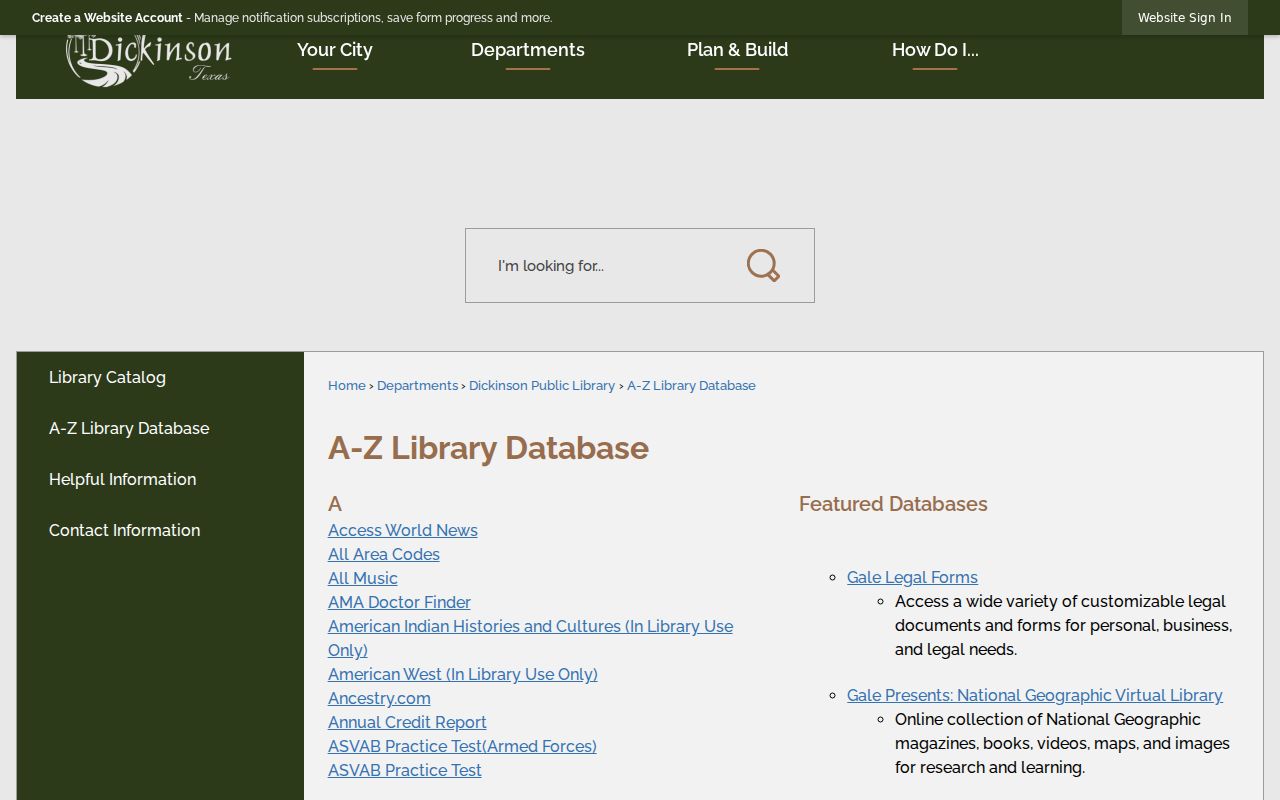
That list is a useful starting point for cross-checking a directory finding, even when access to an electronic resource must be confirmed in advance.
Dickinson Phone Books and Papers
The Dickinson Historical Society holds a digital-archive item titled “Dickinson Phone Book - 1937,” with a December 1937 cover. Its description identifies Associated Telephone Company Limited, now Verizon, and explains that the book contains subscriber names, addresses, and telephone numbers. Cover advertisements add local context, including a beauty shop identified with Mr. and Mrs. Gene Connally and a Texas City funeral-home ambulance service. Those notices place surnames and businesses in time, but they are not a complete household list.
For a nearby date, the digitized Mainland Messenger collection at the Portal to Texas History contains 106 weekly issues and 860 pages published in Dickinson from July 9, 1913 through July 28, 1915. A surname can appear in a notice, advertisement, school item, or community report even when a directory volume is missing. Rosenberg Library also supplied the newspaper collection and was the research base for the historic survey.
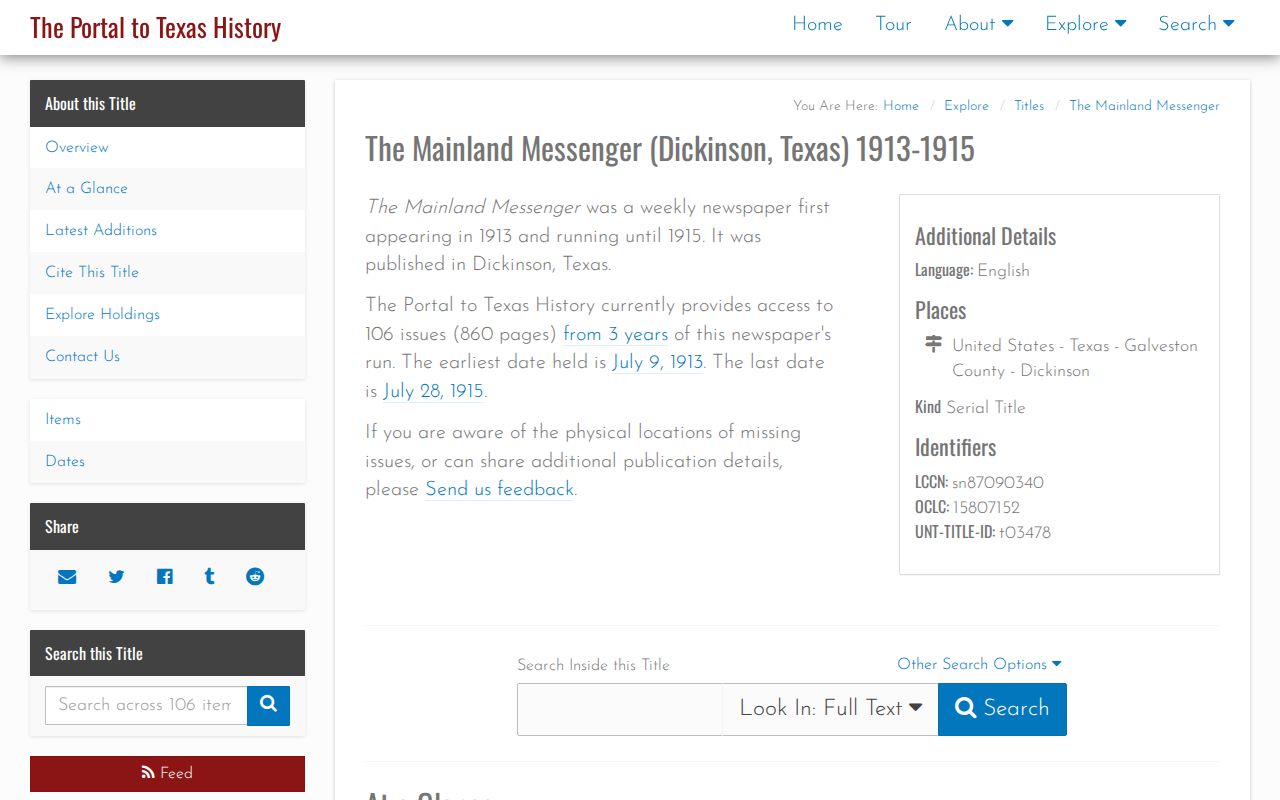
Pair a newspaper hit with the volume date and address before treating it as evidence for the same person or household.
How a Dickinson City Directory Entry Reads
A local entry must be read as the individual volume presents it. The visible 1937 archive item establishes subscriber names, addresses, and telephone numbers, while TSLAC's directory guidance explains that other city books can add a spouse or household notation, occupation, or an owner and occupant mark. Such fields vary by publisher and year. No legible interior 1937 or 1959 Dickinson page with a local abbreviation key was exposed in the research, so a mark should never be expanded from memory.
| Subscriber or householder | Usually a surname-first listing or household name, depending on the volume. |
|---|---|
| Street or rural address | Places the entry at an address or rural route for that edition. |
| Telephone number | Appears in the documented 1937 telephone-book description. |
| Spouse or occupation | May appear in a general city directory, but not every local volume supplies it. |
| Owner or occupant notation | Use only when the book's own key states the meaning. |
- Criss-cross directory
- An address- or street-order section that can lead from a location to an occupant. Its presence in these Dickinson runs is not verified.
- Householder index
- An alphabetical listing organized around a household or subscriber, rather than every person connected to an address.
- Abbreviation key
- The volume's own explanation of shortened labels and symbols. Photograph or copy it before interpreting an entry.
Dickinson City Directories Under Clear Lake Area
The key catalog phrase is “Clear Lake Area.” TSLAC lists its Dickinson holdings under that heading for 1963, 1969, 1971, 1972, 1974, 1976, 1977, and 1979. Rosenberg Library's survey citations add 1964, 1975, and 1977. Search both terms, then inspect the volume's locality heading. These regional books may supply a name and address that a Dickinson-only catalog search would miss.
TSLAC's city-directory holdings list is the right place to confirm the catalog route before consulting the Austin reference room. The regional label is a search aid, not a claim that every Clear Lake Area entry was inside today's Dickinson municipal limits.
Trace Dickinson City Directories With Census
Use a directory as a dated snapshot, then test it with records that answer a different question. Federal decennial census images are public through 1950 under the 72-year release rule. Census material can provide ages and relationships, while a directory can offer an address, subscriber name, or occupation. The comparison is especially useful when two people share a surname or an address changes between editions.
- Identify the volume type, date, locality heading, and page for the surname or address.
- Record the entry exactly, including initials and any shorthand that the volume's key explains.
- Check the next available directory, allowing for missing years and the regional Clear Lake label.
- Pair the nearest directory period with the public federal census and compare address, age, relationship, and occupation.
- Use a deed, probate file, cemetery record, yearbook, or newspaper notice to test a move, death, or family relationship.
A name disappearing can reflect a move, death, an unlisted telephone, a missed edition, or a different catalog heading. It is a lead, not a conclusion. For a current address-based record chain, use the Dickinson street directory rather than treating an older volume as current evidence.
Dickinson Directory Maps and Endpoints
Directory research often needs a place check. The 1992 survey says no Sanborn maps were produced for the unincorporated village, even though the library lists Texas Digital Sanborn Maps. County subdivision plats are the better historic lot-layout substitute. The Dickinson Historical Society's 1991 aerial-view item and county GIS aerial layers can help connect a former business, railroad feature, or school to a later parcel, but a recorded plat controls the legal layout.
For an endpoint, the local archive's “Here They Rest” study documents Magnolia Cemetery names, families, descendants, and World War I veterans. The city also identifies Evergreen, Mount Olivet Catholic, Dickinson Cemetery, and Magnolia as historic cemeteries. Church, cemetery, probate, and newspaper sources can clarify a directory disappearance without assuming why the name left a listing.
Note: No verified Dickinson Sanborn sheet, reverse-directory title, or public local obituary index was located in the researched sources.